Subscribe To This Site
XML RSS
Add to Google
Add to My Yahoo!
Add to My MSN
Subscribe with Bloglines

Home
**FREE Course**
Bike Building Videos
Chopper Plans
Build A Chopper
Custom Chopper Blog
Build A Frame
Maintenance Guides
Custom Painting
Custom Chopper Frames
Chopper Kits
Custom Harleys
Affiliate Program
Site Map
Link Exchange
Contact
Chopper Magazines
 

Chopper Basics: A Simple Look At How Choppers Work...

If you want to learn how to build a chopper from start to finish and study all the fine details involved in every step of the process, this article is not for you. It's simply too large a subject to discuss in one simple article. But if you want to learn the basics of how a chopper is built, and how each of the parts work, you may find this article extremely informative. This article is probably best for the novice chopper enthusiast who wants to take the fist step in learning how to build a chopper.

If you want to ad in any additional information, please contact us and we may include it in this article. We would love to expand on this and make an advanced presentation. And with your help on how to build a chopper we can accomplish this together.

Also, if after you have read this article you want more detailed information I recommend these video's (DVD's) from Covell.

If you are not quite ready to jump in on building your custom chopper, I recommend you read this material (see the bonus material too): How to build a chopper frame.

Following is the brief description about the parts used in chopper motorcycles and a basic guide to what's needed in the process of learning how to build a chopper...

Chopper Basics: The FRAME

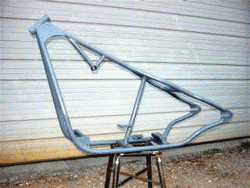
The most important step in learning how to build a chopper is understanding the frame. The frame is one of the most important components on a motorcycle, especially on a large motorcycle. The frame must be designed strong enough and built rigid enough to:

  • Manage the power and torque created by your power train and maintain its alignment during the full range of acceleration/deceleration.
  • Maintain wheel alignment during extreme braking and hard cornering, as well as while riding over rough surfaces.
  • Provide a solid mounting surface and pivot points for the front and rear suspension.
  • Effectively support the weight of the motorcycle itself as well as the rider, a passenger, and travel gear.

Frame Construction

The frame is made from high-strength seamless steel tubing and utilizes a high tensile strength welding process to extremely tight tolerances.

Chopper Basics: Types of Frames:

1) Hidden Shock Frame

hidden shock frame

A) Steering Head B) Frame

C) Rear Forks and Pivot Shafts D) Shock Absorbers

2) Rubber Mount Frame

rubber mount frame

A) Steering Head B) Frame

C) Rear Forks and Pivot Shafts D) Shock Absorbers

3) Rigid Frame

rigid frame

A) Steering Head B) Frame

Chopper Basics: The SUSPENSION SYSTEM (Front & Rear)

In learning how to build a chopper beyond frame design, the suspension system is the chief ingredient in determining the handling capability of a motorcycle. The suspension system is responsible for keeping the wheels on the ground and absorbing the shock as the motorcycle passes over uneven surfaces in the road. Both the front suspension (telescoping front forks) and the rear suspension (rear swing arm and shock absorbers) operate by compressing and extending as the motorcycle passes over a bump, absorbing the shock of the bump to keep the motorcycle stable. The front and rear suspension utilize springs for the up and down compression and extension, and suspension dampers to stabilize the up and down movement. Without the suspension dampers, the springs in the suspension system would continue to bounce up and down after each bump creating a “rocking horse” effect.

FRONT SUSPENSION

Motorcycles use two types of telescopic front fork assemblies: conventional and inverted. Each assembly consists of two fork tubes which contain springs, spring dampers and oil. The fork legs slide on the fork tubes. The tube or leg extends and compresses within itself as a shock absorber. The two types differ in these ways. On the conventional type, the fork tubes are captured by the triple clamp positioning the fork leg at the bottom of the assembly. The inverted type was developed on racing motorcycles to place the heaviest and strongest part, the fork leg itself, in the triple clamp - thus inverting the assembly. This design gives more rigidity to the fork, reducing fork tube flex and lessens the unsprung weight, improving suspension response. The triple clamps (trees) and fork stem hold the front fork tubes to the frame and keep the tubes aligned. The fork stem is an integral part of the triple tree and fits through the steering head allowing the forks to be turned to the right and left.

front suspension front suspension

Inverted Fork Suspension Conventional Fork Suspension

A) Triple Clamps and Fork Stem A) Triple Clamps and Fork Stem

B) Fork Legs B) Fork Legs

C) Fork Tubes C) Fork Tubes

REAR SUSPENSION

There are two types of rear suspension exposed shock absorbers and hidden shock absorbers. The rear fork is attached to the frame with the pivot shaft. The arms of the rear fork (often called the swing arm) hold the rear wheel and keep it aligned. The rear shock absorbers mount to the rear forks and the back struts of the motorcycle. The ability of motorcycle to handle effectively while cornering, breaking, etc. depends in part on the suspension system having the right amount of “controlled flexibility.” Over time or under certain conditions if your suspension seems too rigid or too spongy, it may need servicing or adjustment.

Chopper Basics: The POWERTRAIN

power train

The power train is composed of:

A. V-Twin, 107 cubic-inch, four stroke engine

B. Chain driven primary drive

C. 5-Speed transmission or 6-Speed transmission

D. Belt driven final drive down.

Chopper Basics: How the Engine Works

In learning how to build a chopper, you have to have a thorough understanding of the engine. A four stroke engine means that each piston moves four times (strokes) for the engine to complete one full cycle. Four Strokes of engine are:

Intake Stroke -The piston moves down while the intake valve is open, pulling the air/fuel mixture into the cylinder.

Compression Stroke - The piston moves upward pressurizing the air/fuel mixture.

Power Stroke - As the spark plug ignites the compressed air/fuel mixture, the combustion pushes the piston back down.

Exhaust Stroke - With the exhaust valve open the piston moves upward again, pushing the burned gases out of the cylinder.

The valves opening & closing, the pistons cycling at 3,000 to 5,000 revolutions per minute (at normal operating speeds), the spark plugs firing all occurring in the proper timing is what it takes to keep your motorcycle down the road.

PRIMARY DRIVE:

The purpose of the primary drive is to deliver power from the engine to the gear box. The primary, or initial drive, on your motorcycle is composed of a primary drive chain which runs from the crankshaft in the engine to the clutch in the gear box. The power from the engine to the gear box is engaged and disengaged by the clutch.

TRANSMISSION (GEAR BOX):

The transmission or gear box connects the primary drive to the final drive with a set of shafts and different size gears. Engaging the different size gears in the gear box allows for a wide variety of rear wheel speeds, while allowing the engine to operate "comfortably" within its range of normal operating speeds. Smaller gears provide more torque while larger gears provide more speed. This pairing of different size gears is called “gear ratio” or “gear reduction”. The gear ratio or reduction in your Big Dog power train begins with the primary drive, increases in the gear box and culminates with the final drive.

FINAL DRIVE:

The final drive, is the last link in the power train and connects the gear box to the rear wheel.

Chopper Basics: The BRAKING SYSTEM

braking system

The front brake is a hydraulic disc type, which is operated by the hand lever on the right handle bar. It is composed of:

A. Front disc rotor

B. 4-piston caliper

C. Braided stainless steel lines

D. 5/8" bore master cylinder and fluid reservoir

The rear brake is a hydraulic disc type which is operated by the pedal on the right foot rest. It is composed of:

E. Rear disc rotor

F. 4 piston caliper

G. Braided stainless steel lines

H. 5/8" bore master cylinder and fluid reservoir

How the Braking System Works

The braking system is designed so that the front brake should supply 75% of the braking power or your motorcycle. It should be used as the primary brake while using the rear brake as secondary.

FOR NORMAL BRAKING: Apply both the rear and front brakes while down shifting to match your road speed.

FOR MAXIMUM BRAKING: Close the throttle and firmly apply both rear and front brakes; then pull in the clutch lever before coming to a complete stop to prevent the engine from stalling.

Chopper Basics: The CLUTCH SYSTEM

motorcycle clutch

A. Clutch hand lever
B. Clutch cable
C. Clutch assembly

The clutch assembly is positioned between the

primary drive chain and the gearbox, and provides a way to connect and disconnect the primary drive (power transmitted from the engine) and the gearbox. The clutch assembly is disengaged by pulling the clutch hand lever in against the handlebar grip; it is engaged by releasing the lever. When the engine is running, the primary drive is spinning. As the clutch is engaged (the hand lever released) the power from the engine is transferred to the gearbox and the rear wheel. When the clutch is disengaged (the hand lever pulled closed) the gearbox does not receive power from the engine.

THE CLUTCH ASSEMBLY:

Simply put, the clutch assembly is composed of round discs called “clutch plates” which are contained inside a clutch housing (often called the clutch basket). These plates are pushed together by spring tension. When pushed together, friction between the plates causes them to bind or couple together which provides the link to transfer power from the engine, through the clutch, to the gearbox.

CLUTCH HAND LEVER & CABLE

When the clutch hand lever is pulled, the clutch cable acts against (or relieves) the spring tension within the clutch assembly to release the friction grip inside the clutch. As the clutch plates separate from each other and slip, this de-couples the gearbox from the engine. The clutch assembly is a mechanical wet clutch. Mechanical means that it does not operate by hydraulic pressure. A wet clutch means that the clutch assembly operates immersed in an oil bath. This not only helps to keep the clutch assembly cool, but also washes away loosened friction material from the clutch plates, keeping the surfaces clean and free of debris.

Chopper Basics: The ELECTRICAL SYSTEM

eletrical system

The electrical system provides power for your motorcycle. It is powered by a high cranking, long -life, 12-volt battery. The electrical system can be divided into five sub systems:

1. STARTING SYSTEM

A. Battery

B. Start switch - Not Shown

C. Solenoid (Relay)

D. Starting motor (Starter)

2. CHARGING SYSTEM

E. Alternator

F. Voltage regulator

A. Battery

3. IGNITION SYSTEM

G. Ignition switch and ignition coil

H. Kill switch - Not Shown

I. Electronic Control Unit

J. Spark plugs - Not Shown

4. ACCESSORY SYSTEM

* Lights

* Horn

* Turn Signals

* Warning Lights

* Other Accessories

5. CIRCUIT BREAKER

Chopper Basics: The FUEL SYSTEM

fuel system

A. Fuel tank

B. Fuel supply valve

C. Carburetor and air filter

D. Throttle grip & cable

E. Fuel lines

The fuel system on your motorcycle is a gravity flow system, so no fuel pump is required. Although it is a simple system, it must perform the complicated task of blending (or mixing) the fuel and air together in the right proportions and supply this mixture to the engine.

FUEL SUPPLY VALVE:

The fuel supply valve (petcock) is a manually operated on/off valve designed to control the fuel flow from the gas tank to the carburetor.

CARBURETOR:

The carburetor is the central part as well as the most complex part of the fuel system. Its primary job is it to atomize (break up) the fuel into small droplets, and mix the atomized fuel with the right amount of air. This mixing (or metering) of fuel and air is called the airfuel ratio. It is precisely here (the carburetor’s ability to atomize and properly meter the air-fuel ratio) that performance, as well as fuel efficiency, is won or lost.

carburator

CARBURETOR OPERATION:

In basic terms (see illustration) as air enters the carburetor, its speed increases passing through the bottleneck in the throat of the carburetor. This increase in air speed creates a vacuum within the carburetor which pulls fuel from the fuel reservoir into the air stream. The fuel is atomized and mixed as it enters the air stream and is then provided to the engine.

THROTTLE GRIP AND CABLE:

The throttle grip and cable are connected to the throttle plate or throttle slide inside the carburetor (see illustration). The throttle plate and/or throttle slide controls the flow of air through the carburetor. Opening the throttle allows more air to pass through the carburetor which draws more fuel into the air stream. This results in increased power from the engine.

AIR FILTER:

The air filter keeps airborne dirt and debris from entering the throat of the carburetor and passing into the engine.

Chopper Basics: CONTROLS AND DISPLAYS

rear veiw mirror

TURN SIGNAL SWITCHES:

Located at the base of each handlebar control group. The right handlebar turn signal switch operates the right front and right rear flashing lamps, and the left handlebar turn signal switch operates the left. To operate the turn signal you must depress and release the turn switch.

Chopper Basics: MIRRORS

Generally your Motorcycle is equipped with two mirrors. Adjust the mirrors to clearly reflect the area behind the motorcycle.

speedometer

A. SPEEDOMETER/ODOMETER:

The speedometer registers miles per hour of forward speed. The odometer registers the number of miles the vehicle has traveled.

B. TURN INDICATOR LIGHTS:

The green TURN indicators will flash when turn signals are activated.

C. HIGH BEAM LIGHT:

The blue BEAM indicator light, when lit, signals that the headlamp high beam is on.

D. TRANSMISSION NEUTRAL LIGHT:

The green NEUTRAL light turns on to indicate when the transmission is in neutral.

E. OIL INDICATOR LIGHT:

The red OIL indicator light, when lit, signals that oil is not circulating through the engine. The light will come on when the ignition is turned on prior to starting the engine. With the engine running, this light should be off except possibly at low idle. If the oil pressure indicator light does not go off at speeds above idling, it is usually because of an empty oil tank or diluted oil. In freezing weather the oil feed may clog with ice and sludge, preventing oil circulation.

gear shifter

GEAR SHIFTER: The gear shifter is located on the left side, and is operated with the toe of the left foot. There are five or six forward gears (depending on model) and no reverse. Pushing the lever all the way down (one full stroke) shifts the transmission to the next lower gear, while lifting the lever all the way up (one full stroke) shifts the transmission into the next higher gear. The operator must release the gear shift lever after each gear change to allow the lever to return to its central position before another gear change can be made. The neutral position is between first (low) and second gears. First gear is the last gear position that can be found by pushing the lever full strokes downward. To shift from first gear to neutral, lift the lever half its full stroke.

SIDE STAND:

The side stand is located on the left side of the motorcycle and swings outward to support the motorcycle for parking.

BRAKE PEDAL:

In this article on how to build a chopper, we are going to end it with the brake pedal. The Brake pedal controls the rear wheel brake and is located on the motorcycle's right side. It is operated by the right foot.

~~~~~~~~~~~~~~~~~~~~~~~~~~~~~~~~~~~~~~~~~~~~~~~~~~~~~~~~~~~~~~~~~~~~
If you found this article on Chopper Basics helpful, you will be super impressed with The Custom Choppers Report. It's my quality newsletter that contains custom chopper tips, stories, pictures, special deals, and much more. It's FREE! Click here to sign up for it now. I promise you won't be disappointed.

Here is where to review our chopper industry Links.

Copyright Custom Choppers Guide